Advanced Sound Devices
These 10 terms go further into rhyme and meter, then into word patterns — tools that close reading of poetry and verse drama relies on.
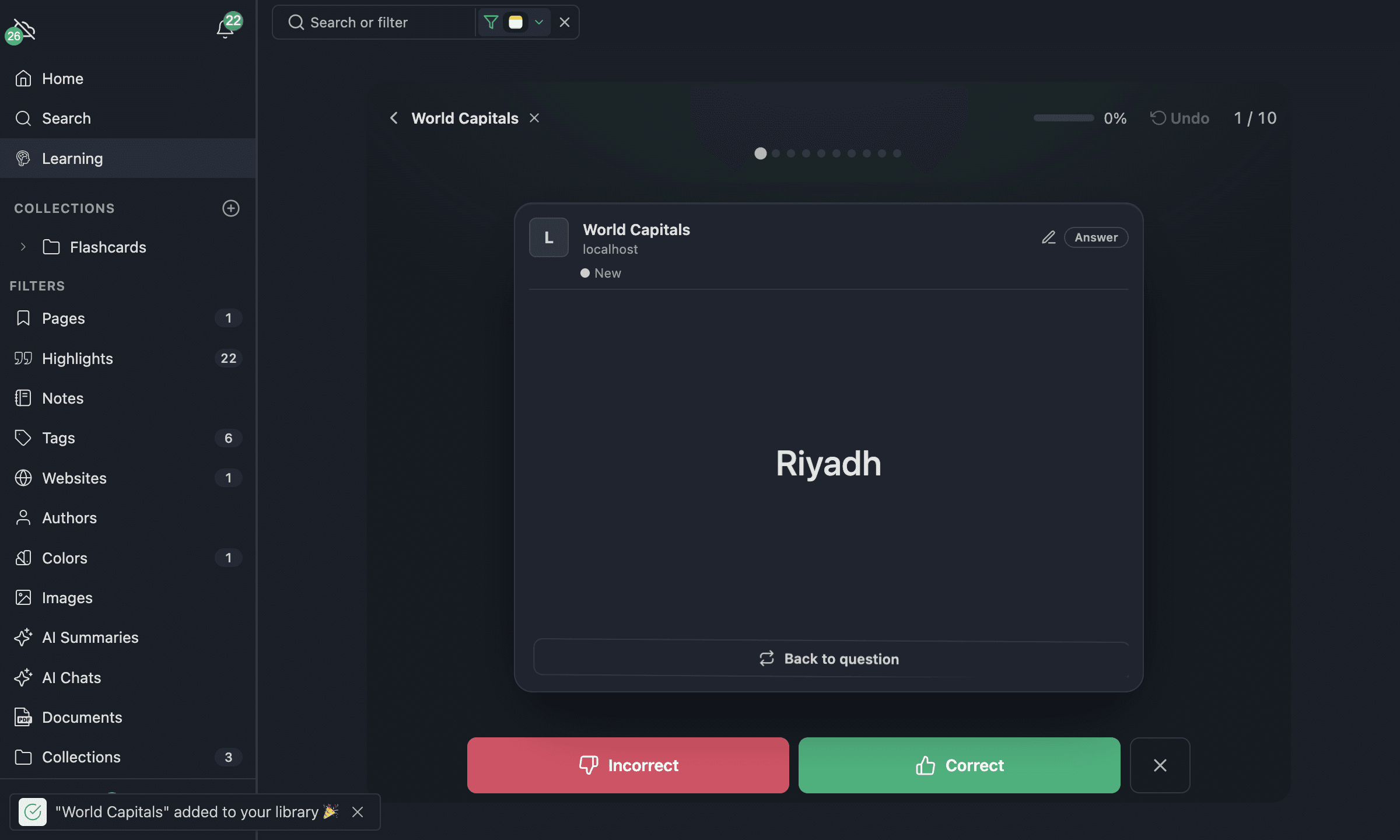
Practice this set for free — no account needed. Loads 10 flashcards into the learner.
Practice in the free learnerHow to study this set
Trochee and spondee are defined by their stress pattern (stressed-unstressed, stressed-stressed) — tap the rhythm out with your hand to hear the difference from an iamb.
All 10 flashcards
Swap question and answerRepetition of "s" and similar hissing sounds for effect.
Sibilance
Poe’s "And the silken, sad, uncertain rustling of each purple curtain" leans heavily on sibilance.
Rhyme that occurs within a single line, not just at line-ends.
Internal rhyme
Poe’s "Once upon a midnight dreary, while I pondered, weak and weary" rhymes "dreary" with "weary" inside one line.
An imperfect rhyme where the sounds are similar but not identical.
Slant rhyme (near rhyme)
"Worm" and "storm" share a near-rhyme, not a perfect one.
Words that look like they should rhyme based on spelling, but are pronounced differently.
Eye rhyme
"Love" and "move" look like a rhyme pair but do not sound alike.
A metrical foot of one stressed syllable followed by one unstressed syllable.
Trochee
Blake’s "Tyger Tyger, burning bright" opens with a trochaic rhythm.
A metrical foot of two stressed syllables in a row.
Spondee
"Heartbreak" is a standard example of a spondee, with heavy stress on both syllables, though scansion in English is open to interpretation.
Repeating the last word of one clause or line as the first word of the next.
Anadiplosis
Yoda’s "Fear leads to anger. Anger leads to hate." repeats the linking word.
A structure where the second half of an expression mirrors the first in reverse order.
Chiasmus
Kennedy’s "Ask not what your country can do for you; ask what you can do for your country" reverses the two halves. Because it repeats the same words, strict usage calls it antimetabole.
Using one word (often a verb) to govern two or more other words, sometimes in a different sense for each, a form called syllepsis.
Zeugma
"She broke his car and his heart" uses "broke" in two different senses at once.
Omitting a sound or syllable, often to fit a metrical pattern.
Elision
"O’er" for "over" is an elision common in older English verse.
What to learn next
That completes Sound and Word Devices. Meaning and Structure Devices, in this same subject, covers the other half of literary analysis.